
shop now
book classes
Master the Markets
shop now
book classes

Forex trading for beginners is one of the easiest ways to start learning how currency markets work, as long as you begin with clear guidance and simple steps. This guide explains the basics in plain English, helps readers avoid common mistakes, and shows how to build a strong foundation before risking real money.
Forex, or foreign exchange, is the market where one currency is traded for another. Beginners often try to jump into trading too fast, but the smarter move is to first understand the market, the risks, and the tools that support learning.
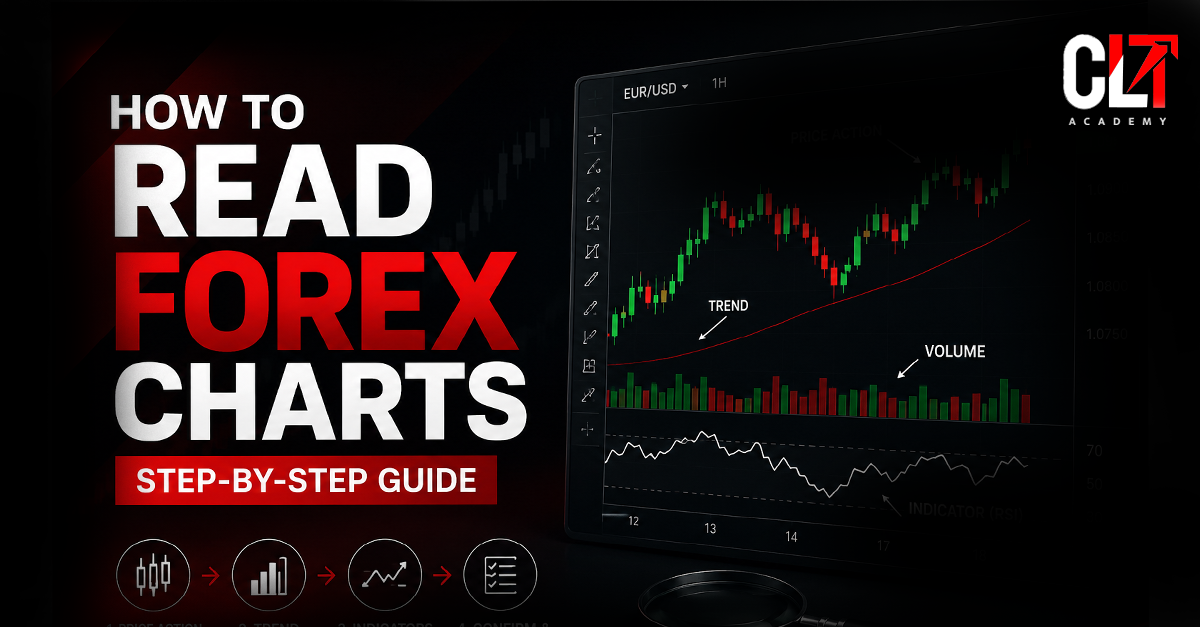
Forex trading means buying one currency and selling another at the same time. A pair like EUR/USD shows the relationship between two currencies, and the price tells you how much of one currency you need to buy the other. Traders try to profit from small price movements, but beginners should first understand the process before focusing on profit.
The market runs almost 24 hours a day, five days a week, because it follows global sessions. It moves because of news, inflation, interest rates, politics, and market sentiment. That is why forex trading for beginners should always start with learning what causes movement, not with guessing direction.
The best way to begin is to build knowledge before opening real trades. Learn the core terms, practice on a demo account, and start with a very small amount if you decide to trade live. A beginner who follows a clear method usually learns faster than someone who jumps from one idea to another.
If you prefer guided training instead of learning entirely on your own, structured programs like CLT Academy’s Courses can help beginners move from basic understanding to practical skill with mentorship and step-by-step support.
Before placing any trade, it helps to understand the most common forex terms.
Once these terms are clear, the rest of forex becomes much easier to understand.
Different traders use different styles, and beginners should choose one that fits their routine and patience. Some styles need fast decisions, while others allow more time to think. The right style is the one you can follow calmly and consistently.
Common styles include:
For many beginners, swing trading is easier because it gives more time to analyze the market without feeling rushed.
Risk management is one of the most important parts of forex trading for beginners. Even a good trade idea can fail, so the goal is not to win every trade but to protect your capital. A small, controlled loss is easier to recover from than a large emotional mistake.
Here is a simple life example: if you receive a monthly allowance or salary, you do not spend all of it on one purchase. You save, plan, and keep money aside for future needs. Forex works in a similar way. You should never place your entire account on one trade; instead, you risk only a small amount so one bad trade does not damage everything.
Good risk habits include:
This is where most beginners improve the fastest, because discipline matters more than excitement.
A trading strategy gives you rules for entry, exit, and risk. Without rules, trading becomes emotional and inconsistent. A simple strategy is better than a complicated one, especially when you are still learning.
A beginner strategy should answer these questions:
The goal is not to create a perfect strategy on day one. The goal is to create a strategy that is simple enough to follow regularly.
You do not need too many tools at the start, but you do need the right ones. A charting platform, a demo account, and an economic calendar are usually enough for beginners. These tools help you practice and stay aware of market events.
Useful tools include:
Keeping the setup simple usually makes learning faster and decisions clearer.
Most beginners lose money because they repeat avoidable mistakes. The problem is usually not the market itself, but the way they approach it. Small mistakes become expensive when repeated many times.
Avoid these errors:
[Download Free Trading Checklist]
Is forex trading good for beginners?
Yes, forex can be suitable for beginners if they start with learning, demo practice, and proper risk management instead of chasing quick profits.
How much money do I need to start forex trading?
You can begin with a small amount, but what matters most is how well you manage risk and trade size.
Can I learn forex trading on my own?
Yes, many beginners learn through structured content, practice, and review. A simple step-by-step approach works better than trying to learn everything at once.
Forex trading can seem overwhelming at first, but every successful trader begins by learning the basics. Understanding currency pairs, managing risk, practicing on a demo account, and following a clear trading plan are all essential steps toward building confidence and consistency.
Trading success comes from education, discipline, and continuous learning rather than chasing quick profits. By focusing on strong fundamentals and developing the right habits, beginners can build the knowledge and skills needed to navigate the forex market with greater confidence.
If you’re ready to take your learning further, you can explore our Courses, learn more about our mentorship approach (About Us), or meet the trading mentors behind CLT Academy (Meet Our Trading Team) to see how structured guidance can accelerate your journey.
Bank for International Settlements (BIS) – Triennial Central Bank Survey
National Futures Association (NFA) – Forex Investor Resources
CME Group – Forex Education
Investopedia – Forex Trading Guide
International Monetary Fund (IMF) – Official Website
20 August 2026 • 10 min read

13 July 2026 • 4 min read

7 July 2026 • 6 min read
Trade Craft
4 weeks
Learn the essentials of trading — from platform basics and price patterns to risk control and market mindset — all in one high-impact, beginner-friendly course..
Profit Matrix
8 weeks
Designed for traders who know the basics but lack execution clarity, this 8-week program dives into advanced trade planning, market psychology, and strategic precision. Take the leap from potential to profitability — and build habits that last a lifetime.