
shop now
book classes
Master the Markets
shop now
book classes
Mathson Mathew
Forex Mentor • Published: 9 November 2026 • 12 min read
Last updated: 9 November 2026
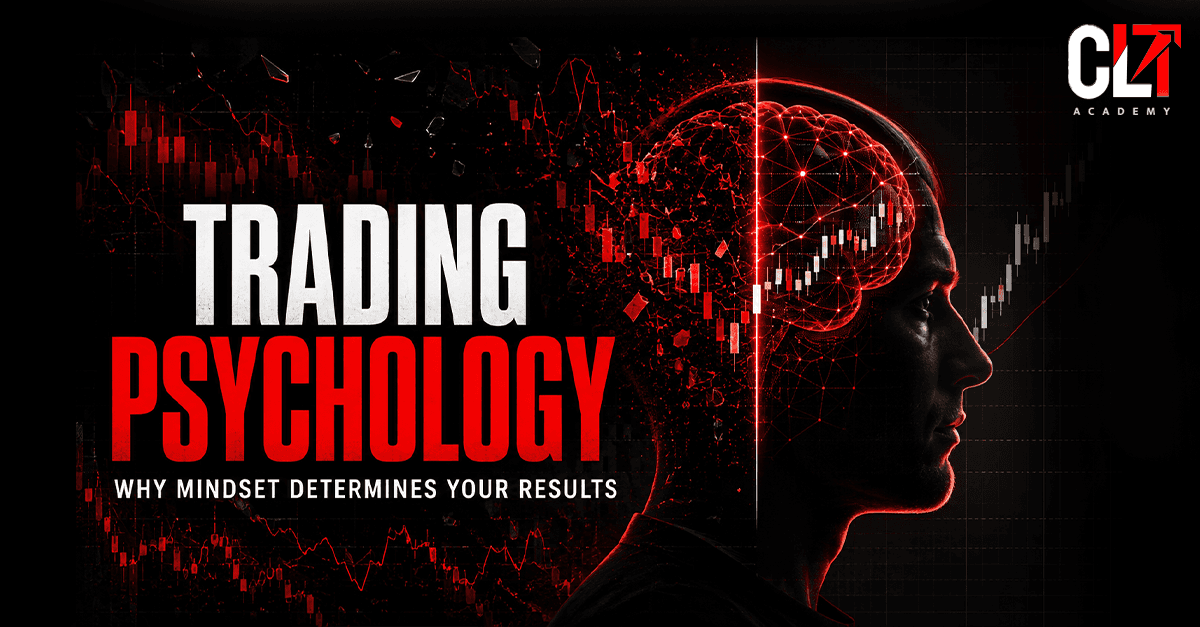
Profile LinkTrading is often presented as a numbers game built around charts, strategies, indicators, and market analysis. But behind every entry and exit is a human decision, and human decisions are influenced by emotions, habits, confidence, fear, and discipline. This is where trading psychology becomes an essential part of a trader's journey.
In this blog, we will look at why mindset can influence trading results, how fear, greed, FOMO, and revenge trading affect decisions, why discipline matters, and how tools such as a trading journal can help traders recognise and improve their behavioural patterns.
Two traders can look at the same chart, use the same strategy, and take the same setup.
One follows the plan.
The other moves the stop-loss, exits too early, enters again out of frustration, or chases the next move.
The market did not change.
Their mindset did.
This is why trading is not only about understanding charts, indicators, price action, or market structure. A trader can have a strong strategy and still struggle because the hardest part often begins after the analysis is complete.
You may know exactly where to enter.
You may know where your stop-loss belongs.
You may even know how much you should risk.
But can you follow that plan when the trade starts moving against you?
Can you stay patient when the market moves without you?
Can you accept a loss without immediately trying to win it back?
That is where trading psychology becomes important.
Trading psychology is the mental and emotional side of trading decisions. It influences how you respond to uncertainty, losses, profits, fear, greed, pressure, and missed opportunities.
Before looking at individual emotions, it is important to understand Trading Psychology as a core part of becoming a disciplined trader.
A strategy tells you what to do.
Your psychology often determines whether you actually do it.
Want to understand your trading behaviour better? Book a 1-on-1 Mentorship.
CLT Academy focuses on helping traders develop clarity, confidence, discipline, and structured execution rather than depending only on signals or strategies. The academy's approach combines market education with practical guidance and ongoing support.
When traders want to improve, the first thing they often look for is another strategy.
A new indicator.
A better entry model.
A different market.
Another trading course.
But strategy is only one part of the equation.
Imagine a trader has a well-defined strategy. The entry conditions are clear, the stop-loss is predetermined, and the risk per trade is controlled.
Then a losing trade appears.
Instead of accepting the planned loss, the trader moves the stop-loss farther away.
Price falls again.
The trader adds another position because the market “has to reverse.”
A manageable loss becomes a much larger one.
The strategy did not necessarily fail.
The trader stopped following it.
This is one of the most important lessons in trader psychology: there is often a difference between what a trader understands intellectually and what they can execute emotionally.
I have seen this distinction repeatedly while working with traders. A trader can explain a setup perfectly during a discussion and still behave differently once real money is involved. That does not always mean the trader lacks knowledge. Sometimes the real issue is that pressure changes the way they execute what they already know.
That is why trading psychology deserves the same attention as technical analysis.
At CLT Academy, the focus is not simply on teaching traders what to see on a chart. The aim is to help them understand the complete decision-making process, from planning and execution to review and consistency.
Build your process with Pro-Level Mentorship
Fear is one of the most common emotions in trading.
A trader enters a position with confidence.
The market moves slightly against them.
Suddenly, the same trader who was confident a few minutes earlier starts thinking:
“What if it keeps falling?”
“What if my analysis is wrong?”
“Should I close now?”
The trader exits.
A few minutes later, price moves toward the original target.
This is not simply a technical mistake.
It is a psychological reaction.
Fear can cause traders to:
The problem is not that fear exists.
The problem is allowing fear to make the decision.
You cannot remove uncertainty from the market. No strategy can guarantee that every trade will work. What you can control is the amount you risk and whether the trade follows your plan.
That is where risk management and emotional control become closely connected.
If your position size is too large, every small price movement can feel significant. When risk is controlled, it becomes easier to evaluate the trade objectively.
I often tell traders to look at the difference between a planned loss and a frightening loss. A planned loss is something you already accepted before entering. A frightening loss is usually the result of risking more than you were mentally prepared to lose.
That difference can completely change your behaviour.
CLT Academy places strong emphasis on goal planning, trade execution, and building clarity around decisions. The academy also highlights the psychological side of trading, including emotional triggers such as fear and greed.
Struggling with fear in your trades? Talk to a Mentor
Most traders expect emotions to become dangerous after a loss.
But winning can create its own psychological trap.
Imagine a trader makes three profitable trades in a row.
Confidence increases.
Then comes the thought:
“I've got this market figured out.”
The trader increases position size.
Then takes a setup that does not fully meet the strategy.
Then another.
One reversal can turn a profitable session into a losing one.
This is where greed and overconfidence become dangerous.
Greed may appear as:
The important lesson is simple:
A winning trade does not make the next trade more likely to win.
Every setup must still be evaluated on its own conditions.
One of the patterns I have seen is that traders sometimes become less disciplined after a good week than after a bad one. During the first few sessions, they follow their rules carefully. After several wins, their confidence grows and the rules slowly become flexible.
Position size increases.
The quality of setups decreases.
The trader begins trading based on confidence rather than probability.
That is why consistency matters more than excitement.
CLT Academy's emphasis on clarity, discipline, and structured execution is designed to help traders avoid confusing a short-term winning streak with permanent skill.
Keep your confidence disciplined with 1-on-1 Mentorship
You open your chart.
Price suddenly shoots upward.
You were not in the trade.
Then you see other traders sharing screenshots of their profits.
Your mind starts racing.
“I should have entered.”
“It's still going up.”
“I can't miss this.”
You enter late.
The market retraces.
This is FOMO — the fear of missing out.
FOMO is powerful because it makes not taking a trade feel like a mistake.
But missing a trade is not necessarily a trading error.
Entering a poor trade because you missed the original setup is.
FOMO can lead to:
The solution is not to catch every move.
The solution is to become comfortable letting some moves go.
There will always be another setup.
I have seen traders become frustrated because a move happened without them. But the market does not owe us an entry. If the original setup is gone, entering late simply because price is moving can turn a missed opportunity into an unnecessary loss.
A disciplined trader does not need to participate in every move.
They need to participate in the moves that fit their plan.
CLT Academy's focus on clarity and structured decision-making helps traders distinguish between a genuine trading opportunity and an emotionally driven entry.
Don't let FOMO control your entries. Book a 1-on-1 Mentorship
Few emotional patterns are as damaging as revenge trading.
The sequence often looks like this:
Loss → frustration → immediate re-entry → larger risk → another loss → more frustration.
At that point, the trader is no longer responding to the market.
They are responding to the previous trade.
After a loss, the mind wants the account balance to return to where it was before the loss. That creates pressure.
Instead of asking:
“Is there a valid setup?”
The trader starts asking:
“How can I make back what I lost?”
That is a dangerous question.
Revenge trading can lead to:
A loss should lead to a review, not an emotional reaction.
This is why understanding Revenge Trading is an important part of developing stronger trading discipline.
I remember seeing traders treat the next trade as a recovery mission rather than a new probability. Once that happens, the objective changes. The trader is no longer asking whether the setup is good enough; they are asking whether it can recover the previous loss.
That is when one trade can begin controlling the next five.
The better response is simple: accept the loss, review it, step away if necessary, and wait for the next valid opportunity.
CLT Academy's approach combines structured learning, trade review, mentorship, and tools designed to help traders identify behavioural patterns instead of repeating them. Its trading journal is specifically positioned around tracking decisions, identifying patterns, and improving discipline.
Break the cycle with 1-on-1 Mentorship
Trading discipline sounds simple.
Follow the rules.
But discipline becomes difficult when the market tests you.
A disciplined trader understands that:
Discipline is not simply having rules written down.
It means following those rules when breaking them feels more attractive.
A simple pre-trade checklist can help:
That last question is particularly useful.
If your answer changes depending on whether you are currently winning or losing, your emotions may be influencing the decision.
When I review trades with traders, one of the first things I look for is the difference between their written plan and their actual execution. Sometimes the trader believes the strategy is failing, but the journal shows that many of the trades did not actually follow the strategy.
You cannot accurately judge a strategy if you keep changing its rules while using it.
CLT Academy follows a structured progression from awareness and planning to foundation, execution, growth, consistency, and mastery. The academy also uses trade journaling as a way to strengthen discipline and make performance more measurable.
Build stronger execution with Pro-Level Mentorship
Here is something many traders overlook:
Your trading history can reveal your psychology better than your memory can.
You may believe your biggest problem is market analysis.
Your journal may tell you something completely different.
Perhaps most of your losses happen after two consecutive wins.
Perhaps you close trades too early whenever volatility increases.
Perhaps you overtrade after your first losing trade.
Perhaps your best trades happen when you risk less and follow a fixed process.
Without recording these behaviours, they are easy to miss.
A useful trading journal should record more than entry and exit prices.
Over time, this turns trading psychology from an abstract concept into something measurable.
Instead of saying:
“I think I panic after losses.”
You may eventually discover:
“Most of my rule-breaking trades happen immediately after a losing trade.”
That is useful information because now you have a behaviour you can work on.
This is one reason I encourage traders to record their decisions rather than relying on memory. A journal can reveal patterns that are almost impossible to notice when you look at each trade individually.
CLT Academy's Digital Trading Journal is built around this principle: tracking trades, identifying patterns, improving discipline, and using performance information to make better decisions.
Turn your trade history into useful feedback with CLT Academy's Trading Journal
Trading psychology is not something you fix in one afternoon.
It develops through repeated behaviour.
The goal is not to become emotionless. That is unrealistic.
The goal is to notice emotions without allowing them to control your trade.
Here are some practical habits that can help:
Know how much you are willing to lose before opening the position.
Your entry, exit, stop-loss, and position-sizing rules should not be decided emotionally in the middle of a trade.
A losing trade does not automatically mean your strategy is bad.
If you miss an entry, let it go. Another opportunity will come.
If you feel angry, desperate, unusually excited, or fearful, consider stepping away instead of forcing a trade.
Use a journal to identify recurring behavioural patterns.
A profitable trade that broke every rule is not necessarily a good trade. A losing trade that followed your plan can still be good execution.
That distinction can completely change how you learn.
One of the mindset shifts I encourage traders to make is moving from “Did I make money?” to “Did I execute correctly?”
If profit is the only measure, every loss feels like failure and every win feels like proof that you were right. When execution becomes the measure, both winning and losing trades can provide useful information.
CLT Academy's broader learning process is built around awareness, planning, foundation, execution, growth, consistency, and mastery. Its mentorship and trading resources are designed to help traders develop clarity and discipline alongside their technical skills.
Work on your mindset with 1-on-1 Mentorship
The market does not know whether you are nervous.
It does not know whether you just lost three trades.
It does not know whether you desperately need today's trade to be profitable.
The chart simply moves.
Your psychology determines how you respond.
That is why becoming a better trader is not only about finding a better strategy. It is about developing the discipline to execute that strategy through uncertainty.
Fear will appear.
Greed will appear.
FOMO will appear.
Losses will happen.
Winning streaks will happen.
The difference between an inconsistent trader and a disciplined trader is often what happens next.
A strong trader does not need to win every trade.
They need to make decisions that remain sensible across many trades.
That is the real purpose of trading psychology.
At CLT Academy, the focus goes beyond technical knowledge. The academy combines structured education, practical market learning, mentorship, trade review, and tools designed to help traders develop clarity and discipline.
Ready to build a more disciplined trading process? Book a 1-on-1 Mentorship
1. What is trading psychology?
Trading psychology refers to the mental and emotional factors that influence a trader's decisions. It includes how traders handle fear, greed, losses, uncertainty, FOMO, confidence, patience, and discipline.
2. How can I improve my trading psychology?
Start by defining your risk before entering trades, creating clear rules, maintaining a trading journal, reviewing your decisions, and separating execution quality from individual trade outcomes. Structured mentorship can also help identify behavioural patterns that may be difficult to recognise alone.
3. Why do traders revenge trade after a loss?
Revenge trading usually happens when a trader becomes focused on recovering a recent loss instead of waiting for the next valid setup. This emotional pressure can lead to overtrading, excessive risk, and decisions outside the trader's normal strategy.
Investopedia — Trading Psychology (https://www.investopedia.com/terms/t/trading-psychology.asp)
CLT Academy — Trading Education & Mentorship (https://clt-academy.com/)
CLT Academy — Digital Trading Journal (https://clt-academy.com/addons)
CLT Academy — Contact & Mentorship (https://clt-academy.com/contact)
22 June 2026 • 6 min read

4 March 2026 • 3 min read
29 October 2026 • 13 min read
Profit Matrix
8 weeks
Designed for traders who know the basics but lack execution clarity, this 8-week program dives into advanced trade planning, market psychology, and strategic precision. Take the leap from potential to profitability — and build habits that last a lifetime.
CLT Vantage
28 weeks
This 6-month program doesn’t just teach trading. It builds leaders capable of thinking like fund managers, mentoring others, and navigating market chaos with clarity.