
shop now
book classes
Master the Markets
shop now
book classes
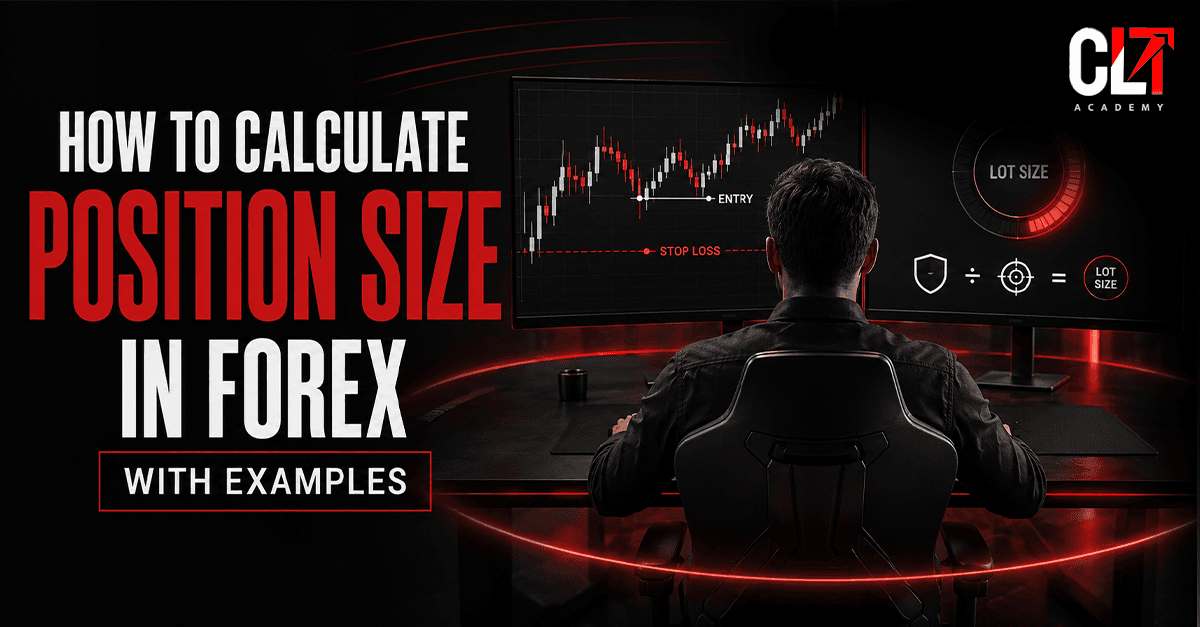
A good Forex trade is not only about finding the right entry. You also need to know how much to trade.
You can identify the market direction correctly, wait for a strong setup and place a logical stop-loss, but an oversized position can still turn a manageable losing trade into a serious account drawdown.
That is why position sizing is a fundamental part of Forex risk management.
Position sizing connects your:
to one practical question:
How large should this trade actually be?
One of the common mistakes I see among developing Forex traders is deciding the lot size first.
They find a setup, feel confident about it and think, “I will take 0.50 lots on this trade.” Only after deciding the position size do they start thinking about where the stop-loss should go.
The process should be the other way around.
First, decide how much you are willing to risk. Then identify where the trade idea becomes invalid. Finally, calculate the position size that keeps the potential loss within your predefined risk.
That is the foundation of position size calculation forex traders need to understand.
For example, if your account is $10,000 and you decide to risk 1%, your maximum planned risk is $100.
But that $100 does not automatically tell you how many lots to trade.
Your stop-loss distance and pip value still matter.
The 1% rule can help establish how much you are prepared to risk, while position sizing helps convert that risk into an actual trade size.
I remember a student who was very good at identifying setups but kept increasing his lot size whenever he felt particularly confident about a trade. His analysis wasn't always the problem. His risk calculation was.
We went through his previous trades one by one. Once he started calculating the risk first and adjusting his position size accordingly, his trading became much more structured. He didn't suddenly start winning every trade. That was never the objective. The difference was that his losing trades were no longer unnecessarily damaging his account.
That is the real purpose of position sizing.
Want to put the calculation into practice? Try the Free Position Size Calculator.
Position size refers to the amount of currency you buy or sell in a trade.
In Forex, position size is commonly expressed in lots:
But knowing what a standard, mini or micro lot is does not tell you which lot size you should use.
There is no universally correct position size.
A 1-lot trade may be manageable for one account and far too large for another. Even for the same trader, the appropriate position size can change from one setup to another because the stop-loss distance may be different.
The better question is not:
“How many lots do I normally trade?”
It is:
“How many lots can I trade while keeping this particular trade within my risk limit?”
That shift in thinking can change the way you approach Forex trading.
At CLT Academy, risk management is treated as part of the trading process itself. Position size is not something to calculate after opening a trade. It should be part of the preparation before the order is placed.
Imagine two traders with identical $10,000 accounts.
Both decide to risk 1%, giving them a maximum planned risk of $100.
Both identify the same EUR/USD setup, use the same entry and follow the same trading idea.
Now imagine Trader A calculates the position size according to a 50-pip stop-loss.
Trader B simply opens 1 standard lot because that is the size he normally trades.
The market hits the stop-loss.
Trader A may lose approximately the amount he planned to risk.
Trader B could lose substantially more than his intended risk.
Their analysis was identical.
Their risk was not.
This is why position sizing matters.
A trader can have:
and still have poor risk management if the position size is wrong.
The position size should adapt to the risk of the trade, not the other way around.
The stop-loss should be based on the trade idea. The position size should then adapt to that stop.
I once reviewed the trades of a student who was moving his stop-loss closer whenever he wanted to increase his lot size. His intention was to “protect the account” while keeping a larger position.
The problem was that normal market fluctuations were hitting those artificially tight stops.
Once we reversed the process—logical stop first, position size second—his trade management became much more consistent.
This is one of the practical areas where structured risk management can make a difference at CLT Academy.
Build a more consistent risk-management routine with CLT Academy.
To understand position sizing, you don't need complicated mathematics.
You need to understand the relationship between a few basic numbers.
Your account balance gives you the starting point.
Suppose your account contains:
$10,000
If you decide to risk 1%:
$10,000 × 1% = $100
Your maximum planned risk is therefore $100.
The percentage remains the same, but the monetary amount changes with the account size.
This is why thinking in percentages can be more useful than simply saying, “I always risk $50.”
A $50 loss means something very different in a $2,000 account compared with a $50,000 account.
Read the 1% Risk Rule to understand fixed-percentage risk.
Your risk percentage is the portion of your account you are prepared to lose if your stop-loss is triggered.
It is important to understand that this is a maximum planned risk, not a guarantee that the final loss will always be exactly that amount.
Spread, slippage and commissions can affect the final result.
The purpose is to establish a clear boundary before entering the trade.
A trader without a predefined risk limit can easily make the position-size decision emotionally.
A trader with a predefined limit has a number to work with.
The stop-loss tells you how far the market can move against your position before you accept that the original trade idea is no longer valid.
For example:
That 50-pip distance becomes an important input in your position size calculation.
If the stop-loss becomes wider, the position size generally needs to become smaller if you want to maintain the same monetary risk.
This is where many new traders get confused.
They see a wider stop and think:
“More room means more risk.”
Not necessarily.
The position size can compensate for the additional distance.
Strengthen your pre-trade risk process with CLT Academy's trading resources.
The basic idea behind position sizing is:
Position Size = Maximum Risk ÷ Risk Per Unit
For Forex trading, a simplified version is:
Position Size = Maximum Risk ÷ (Stop-Loss in Pips × Pip Value)
The exact calculation can become more detailed depending on the currency pair, account currency and position size.
Pip value can vary depending on the pair and the account denomination.
Most major currency pairs generally use the fourth decimal place for a pip, while Japanese yen pairs generally use the second decimal place.
So it would be a mistake to assume that every 50-pip move automatically equals the same amount of money.
The pip value matters.
If you are still learning concepts such as pips, lots, leverage and currency pairs, understanding those fundamentals will make position size calculation forex much easier.
Start with CLT Academy's Forex Beginner's Guide if these concepts are still unfamiliar.
Let's make the calculation practical.
Suppose a trader has:
For this simplified example, assume a pip value of approximately $10 per pip for one standard lot of EUR/USD in a USD-denominated account.
Therefore:
50 pips × $10 = $500
One standard lot would represent approximately $500 of risk at a 50-pip stop.
But the trader only wants to risk $100.
Therefore:
$100 ÷ $500 = 0.20 lots
Approximate Position Size = 0.20 lots
If the stop-loss is hit, the planned loss would be approximately $100, before considering spread, commissions and slippage.
The important lesson isn't that every $10,000 account should trade 0.20 lots.
It shouldn't.
Change the stop-loss, risk percentage, account size or currency pair, and the result can change.
Don't memorize the answer.
Understand the process.
If you remember only that “$10,000 account means 0.20 lots,” you haven't learned position sizing.
If you understand:
Account Size → Risk → Stop-Loss → Pip Value → Position Size
you can calculate the appropriate trade size for different situations.
That is the skill that matters.
Calculate your own example with the Free Position Size Calculator.
Let's keep everything else unchanged.
Account: $10,000
Risk: 1%
Maximum Risk: $100
But now suppose the stop-loss is 100 pips instead of 50 pips.
Using the same simplified EUR/USD assumption:
100 pips × $10 = $1,000
One standard lot would represent approximately $1,000 of risk.
To keep the risk around $100:
$100 ÷ $1,000 = 0.10 lots
*Illustrative EUR/USD example using an approximate $10-per-pip value for one standard lot.*
Look at what changed.
The account didn't change.
The risk percentage didn't change.
The maximum monetary risk didn't change.
Only the stop-loss distance changed.
So the position size changed.
Wider Stop → Smaller Position
Tighter Stop → Larger Position
Provided the maximum monetary risk remains unchanged.
This is one of the most useful relationships to understand when learning Forex risk management.
Review your stop-loss and risk framework before your next trade.
I once reviewed the trading history of a student who proudly told me, “I have made my trading very systematic. I always use 0.50 lots.”
At first, it sounded disciplined.
Then we looked at the stop-loss distances.
One trade had a 20-pip stop.
Another had a 60-pip stop.
Another had a 100-pip stop.
The lot size was the same, but the risk was nowhere near the same.
That was when the student understood the difference between fixed position size and fixed risk.
This is a mistake that can look like discipline from the outside.
But consistency in lot size does not necessarily mean consistency in risk.
The exact monetary risk depends on the pip value, but the relationship is clear:
Same lot size does not mean same risk.
That is why your position size should respond to the parameters of each trade.
At CLT Academy, this is one of the areas we emphasize when helping traders move from simply placing trades to actually managing them.
Not automatically.
Suppose two traders each have:
Account: $10,000
Risk: 1%
Maximum Risk: $100
Trader A uses a 25-pip stop.
Trader B uses a 100-pip stop.
Trader B has a much wider stop, but he can reduce his position size so that his maximum planned monetary risk remains around $100.
This is why the stop-loss and position size should be considered together.
The stop-loss should be placed where the trade idea becomes invalid.
The position size should then be calculated around that stop.
Not the other way around.
> “I want to trade 1 lot, so I'll keep the stop-loss very close.”
Instead:
> “My trade becomes invalid here. How large can my position be while keeping my risk within my limit?”
That is a much healthier approach to position sizing.
I have seen traders repeatedly bring their stop-loss closer simply because they wanted to increase their lot size. Eventually, a small normal market fluctuation would hit their stop even though the original trade idea was still valid.
They weren't managing the market.
They were managing the lot size.
Learn more about practical risk management through CLT Academy.
Leverage is another area where traders can easily misunderstand risk.
Leverage can allow you to control larger market exposure with a smaller amount of margin.
But having access to higher leverage does not mean you should automatically increase your position size.
These concepts are connected, but they are not interchangeable.
A broker may allow you to open a large position.
That does not mean your trading plan should allow it.
I have seen beginners become excited after discovering how much exposure their account can control through leverage. The first question they ask is often:
“How much can I trade?”
The better question is:
“How much should I trade?”
That is where risk management comes in.
Learn more about leverage, margin and risk through CLT Academy's Forex education resources.
Pip value represents the monetary impact of a one-pip movement for a particular position.
It is an important part of position sizing because a price movement needs to be translated into money before you can calculate your risk.
Pip value can depend on:
This is why the same number of pips does not automatically represent the same monetary gain or loss in every situation.
For example, a 50-pip movement on a micro lot and a 50-pip movement on a standard lot have very different monetary consequences.
For traders who are still learning the basics, understanding pips and lots first can make the position sizing calculation much easier.
Strengthen your Forex fundamentals with CLT Academy's beginner trading resources
One of the habits I try to develop in traders is calculating position size before opening the order.
Why?
Because once a trader becomes emotionally involved in a setup, it becomes easier to justify a larger position.
A better process is:
I remember a student who used to open the chart, find an entry and immediately move to the order window. Only there would he decide the lot size.
We changed one thing.
Before opening the order window, he had to write down his maximum risk and stop-loss distance.
After a few weeks, he told me, “I'm taking fewer impulsive trades because I have to calculate before entering.”
That is exactly the kind of behavioral improvement good risk management can create.
Position sizing is therefore not only mathematics.
It can also be a discipline mechanism.
Make pre-trade risk calculation part of your daily trading routine.
A position size calculator simplifies the mathematical part of the process.
Depending on the calculator, you may enter:
The calculator then helps determine the appropriate position size based on those inputs.
But there is an important distinction.
A position size calculator does not tell you:
Its job is much simpler:
“Given my risk and stop-loss, how large should my position be?”
That makes it a useful practical tool, especially when calculating several trades or working with different currency pairs.
Download the Free Position Size Calculator and use it before your next trade
Before clicking Buy or Sell, I recommend asking yourself three simple questions.
Is it based on the actual trade idea and market structure?
Or did I choose it simply because it gives me the lot size I want?
Have I converted my risk percentage into an actual monetary amount?
For example:
$8,000 × 1% = $80
Have I calculated the lot size based on my stop-loss and pip value?
Or did I simply choose the size I normally use?
These questions can take less than a minute.
But they can prevent unnecessary risk.
I often tell students that the most important moment of a trade can be before the trade even exists.
Once the order is open, you are managing an active position.
Before the order is open, you are still in control of the decision.
Explore more practical trading habits from CLT Academy
The 1% rule and position sizing answer two different questions.
The 1% rule asks:
“How much am I willing to lose?”
Position sizing asks:
“How large can my trade be while staying within that limit?”
For example:
Account: $10,000
Risk: 1%
Maximum Risk: $100
That $100 becomes your risk budget.
Then your stop-loss distance and pip value determine the position size.
The sequence becomes:
Account Size
↓
Risk Percentage
↓
Maximum Monetary Risk
↓
Stop-Loss
↓
Pip Value
↓
Position Size
The 1% figure itself should not be treated as a magic number.
The larger lesson is to have a predefined risk limit and make your position size respect it.
Read the 1% Risk Rule and understand how fixed-percentage risk can fit into a trading plan
If you want to simplify the entire concept, think about position sizing this way:
Your account tells you how much you have.
Your risk percentage tells you how much you are willing to lose.
Your stop-loss tells you how much room the trade needs.
Your pip value tells you what each movement is worth.
Your position size brings all of those numbers together.
Once you understand that relationship, position sizing becomes much less intimidating.
It stops being a calculation you fear and becomes part of your normal trade preparation.
At CLT Academy, this is the kind of practical understanding we want traders to develop—not simply memorizing formulas, but knowing why the formula matters.
Explore more practical trading education from CLT Academy
Trading naturally makes us think about profit.
How much can this setup make?
How far can the market move?
What is the reward?
But every trader also needs to ask:
No strategy can eliminate losing trades.
No setup is guaranteed.
No trader can predict every market movement.
The objective of position sizing is not to make losing trades disappear.
It is to make sure that one losing trade remains a manageable event.
I have worked with traders who were desperately trying to increase their win rate when their bigger problem was actually position size. They were spending hours searching for better entries while taking unnecessarily large positions.
Sometimes the solution is not another indicator.
Sometimes it is simply reducing the amount you are putting at risk.
That is one of the most important lessons risk management can teach a trader.
Build a stronger risk-first approach with CLT Academy's trading education
Position sizing is where risk management becomes an actual trading decision.
Knowing that you want to risk 1% is only the beginning.
You still need to determine:
The core process is simple:
Risk first.
Stop-loss second.
Position size third.
Don't increase your lot size simply because a setup looks strong.
Don't use the same lot size on every trade without considering the stop-loss.
And don't confuse available leverage with appropriate risk.
You don't need to know exactly what the market will do next to manage your risk properly.
You need to know what you are prepared to lose if the market does not do what you expect.
Position sizing helps turn that decision into a number.
And once risk becomes measurable, it becomes much easier to manage.
Position size is calculated using your maximum monetary risk, stop-loss distance and pip value.
A simplified formula is:
Position Size = Maximum Risk ÷ (Stop-Loss in Pips × Pip Value)
The exact calculation can vary depending on the currency pair, account currency and trade specifications.
Learn more about practical Forex risk management with CLT Academy
Not necessarily.
If your maximum monetary risk remains unchanged, a wider stop-loss generally requires a smaller position size.
This allows the trade more room to move while keeping the planned monetary risk within your limit.
Use the Free Position Size Calculator to test different stop-loss distances
Not necessarily.
Using the same lot size can result in different levels of monetary risk when stop-loss distances or pip values change.
Position size should generally be calculated according to the specific risk parameters of each trade.
Explore CLT Academy's risk-management resources for a more structured approach to trading
19 October 2026 • 10 min read
13 October 2026 • 10 min read
23 September 2026 • 12 min read
Profit Matrix
8 weeks
Designed for traders who know the basics but lack execution clarity, this 8-week program dives into advanced trade planning, market psychology, and strategic precision. Take the leap from potential to profitability — and build habits that last a lifetime.
Market Code
14 weeks
Designed for experienced traders seeking structured mastery, this 14-weeks program unpacks high-level chart analysis, risk-to-reward systems, and real-time strategy execution. Elevate from scattered results to strategic consistency