
shop now
book classes
Master the Markets
shop now
book classes
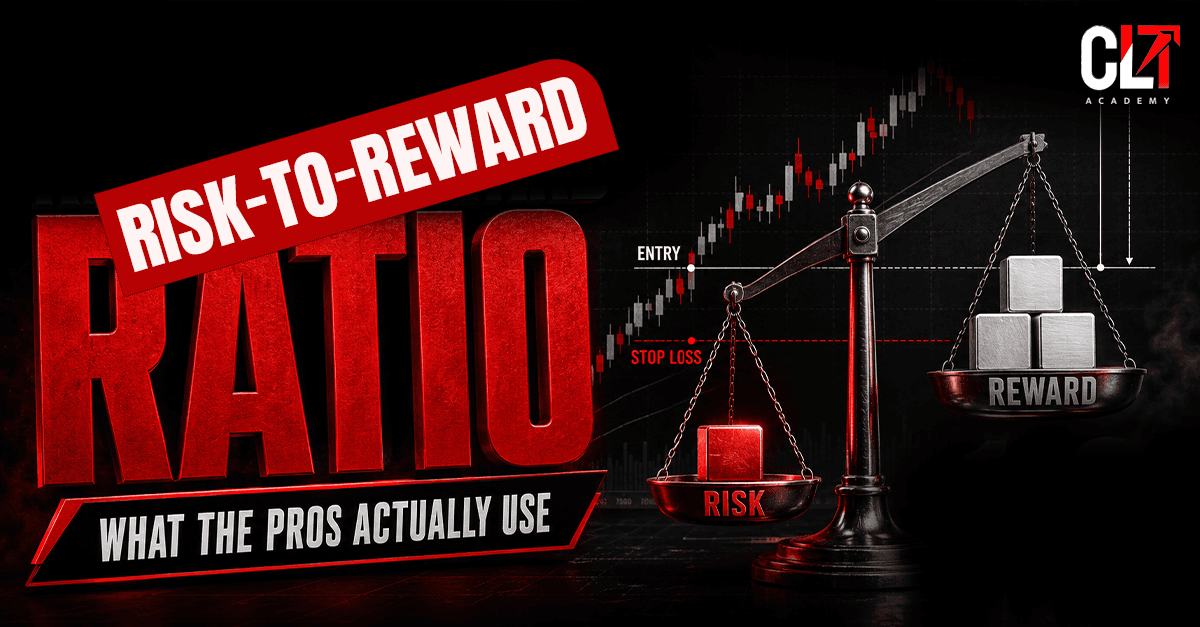
Most traders learn the risk-to-reward ratio as a simple number: 1:2, 1:3, or 1:5. But professional trading is not about finding the biggest number. Experienced traders look at the quality of the setup, where the trade becomes invalid, how far price can realistically move, and how much capital should be exposed before deciding whether a trade is worth taking.
That is the real purpose of risk-to-reward ratio trading: not to predict the market, but to make the potential outcome of a trade measurable before taking the risk.
The risk-to-reward ratio compares the potential loss on a trade with its potential profit.
If a trader risks $100 to potentially make $200, the trade has a 1:2 risk-to-reward ratio. If the potential profit is $300, the ratio becomes 1:3.
The calculation is simple. The professional application is more nuanced.
A common mistake is to assume that a higher ratio automatically means a better trade. It does not. A 1:5 setup can be less attractive than a well-structured 1:2 setup if the 1:5 target is unrealistic or the probability of reaching it is very low.
Professional traders therefore consider several variables together:
Risk-to-reward is one measurement within a broader risk management in trading process.
Want to build a structured approach to trading risk? Explore our Mentorship Program.
The risk-to-reward ratio tells a trader how much potential reward is available relative to the amount being risked.
For example, imagine a trader buys a currency pair at 1.1000 and places a stop loss at 1.0950. The trader is risking 50 pips.
If the target is 1.1100, the potential reward is 100 pips.
That creates a 1:2 risk-to-reward ratio.
The same principle can be applied to forex, stocks, indices, commodities and crypto, although the way risk is measured can differ between markets.
The important part is knowing the potential loss and potential reward before entering the trade.
For someone still building their trading foundation, understanding how currency pairs, orders, spreads and market movements work is equally important.
Forex Trading for Beginners — The Complete Guide
That allows the trader to make a decision based on a defined plan rather than reacting after the position is already open.
Suppose I identify a bullish setup on a currency pair.
My first question would not be, “Can I get 1:3?”
I would first ask:
Only after answering those questions would I calculate the risk-to-reward ratio.
That sequence matters because the ratio should come from the trade structure, not the other way around.
There is no universal ratio used by all professional traders.
A strategy may work with 1:1.5, another may target 1:2, while a trend-following strategy may occasionally offer 1:3 or higher. The appropriate ratio depends on the strategy and the conditions in which it is being traded.
The mistake is turning a useful measurement into a rigid rule.
A professional trader is not trying to force every setup into 1:2 or 1:3.
The better question is:
Does the potential reward make sense for the risk and probability of this particular setup?
If a setup naturally gives me a 1:2 ratio with a realistic target, I would not automatically reject it because another setup might offer 1:4.
Likewise, I would not stretch a target simply to turn a 1:2 trade into 1:4.
If the market structure does not support the larger target, the number is only attractive on paper.
If you want to develop this kind of structured trade evaluation, our Mentorship Program can help.
A higher potential reward sounds attractive.
But the target also has to be achievable.
The mathematics show why traders pay attention to reward-to-risk relationships. But these percentages do not tell us whether a particular strategy will actually achieve those results.
A 1:4 setup may require price to travel much farther than a 1:2 setup. If the market regularly reverses before reaching the larger target, the theoretical advantage may disappear.
This is why professional risk management combines the ratio with probability and historical evidence.
A stop loss in trading should also be placed where the original trade idea becomes invalid, rather than being moved simply to create a more attractive ratio.
*Before spreads, commissions, slippage and other trading costs.
Imagine two possible trades.
Trade A offers 1:2, with the target sitting at a clear market-structure level.
Trade B offers 1:4, but the target sits beyond several areas where price has historically struggled.
I would not automatically choose Trade B because “4 is bigger than 2.”
The quality of the path to the target matters just as much as the size of the target.
Understand how stop-loss decisions fit into complete risk management with our Mentorship Program.
Risk-to-reward becomes much more useful when it is considered alongside win rate.
Suppose a strategy uses a 1:2 risk-to-reward ratio.
If a trader loses two trades and wins one:
If the trader wins more frequently than that over a sufficiently large sample, the strategy could potentially produce positive expectancy before trading costs.
This does not mean a trader should simply target a particular win rate.
The important point is that win rate and average win/loss size work together.
A trader should therefore track:
This is where a trading journal becomes more valuable than guesswork.
Understanding these principles is also part of building a complete risk management in trading framework.
If I am testing a strategy, I would not judge it after three or five trades.
I would collect enough trades to understand how the setup behaves across different market conditions.
Then I can ask:
That gives me evidence to work with instead of relying on a ratio that simply looks good.
Build a measurable trading process through structured guidance in our Mentorship Program.
Trading expectancy connects the probability of winning with the average size of wins and losses.
A simplified expectancy calculation is:
Expectancy = (Win Rate × Average Win) − (Loss Rate × Average Loss)
The example shows why neither win rate nor risk-to-reward should be judged in isolation.
Strategy A wins more frequently.
Strategy B wins less frequently but makes more when it wins.
What matters is the combined result over a meaningful sample of trades.
This is also why professional traders often focus on the performance of the system, rather than becoming emotionally attached to individual trades.
CLT Academy's approach is built around understanding the reasoning behind trading decisions, not memorizing isolated formulas.
The Academy's structured programs cover trading concepts such as risk management, market analysis, strategy development and practical decision-making, helping learners build a more complete understanding of how different trading elements work together.
One of the most important principles in risk management in trading is that the stop loss should have a logical reason for being where it is.
A stop loss may be placed beyond:
The exact method depends on the strategy.
What should not happen is this:
Desired 1:3 ratio → artificially tight stop → unrealistic target
A more logical sequence is:
Trading setup → Entry → Logical stop → Realistic target → Risk-to-reward → Position size
CME Group's trading education similarly emphasizes identifying the stop level first and using that risk level when determining appropriate position size.
If my technical setup says the trade idea is invalid 40 pips away from entry, I do not move the stop to 20 pips simply because doing so produces a higher ratio.
Instead, I accept the actual technical risk and adjust my position size accordingly.
That is a much healthier way to think about risk.
Risk-to-reward tells you the relationship between potential loss and potential gain.
Position sizing determines how much money that relationship represents.
Imagine two traders have exactly the same setup:
Trader A risks $50.
Trader B risks $500.
Both trades have the same ratio.
They do not have the same financial exposure.
This is why position sizing is an essential part of a complete risk-management process.
CME Group notes that position size can be adjusted according to the stop-loss distance and the amount of account capital a trader is willing to risk.
A wider stop does not automatically mean a larger dollar loss. The position size can be reduced to keep the planned monetary risk within the trader's limit.
If my strategy requires a wider stop because the market is volatile, I would rather reduce my position size than force the stop into a level where normal market movement could remove me from the trade.
The objective is not to make every stop smaller.
The objective is to keep the actual risk controlled.
CLT Academy's trading programs cover risk management, market behaviour and practical trade planning as connected skills.
Explore the Mentorship Program to develop these skills with structured guidance.
A risk-to-reward ratio cannot be separated from market context.
The same 1:3 setup can have a very different probability of success in a strong trend and in a sideways market.
Price may have enough momentum and structure to support a larger target.
Price may repeatedly move between defined levels, making an extremely distant target less realistic.
Normal price swings may be larger, requiring a trader to account for greater movement when defining the stop.
Price may simply not travel far enough within the intended holding period to reach a large target.
Market conditions therefore influence both the stop and the target.
This is another reason professional traders do not use one fixed ratio for every situation.
A ratio that works well for my strategy during a strong directional move may not make sense when the same market enters a narrow range.
The strategy has not necessarily become “bad.”
The market environment has changed.
A professional process recognizes that difference.
Learn to adapt your trade planning to market conditions through our Mentorship Program.
A trader may reject a valid setup because it offers only 1:2. The ratio should fit the setup, not the other way around.
A tighter stop may create a better mathematical ratio while making the trade technically weaker.
A target should have a market-based reason. It should not exist simply because the trader wants a larger reward.
Spreads, commissions and slippage affect actual results.
Moving a stop farther away because the trade is losing changes the original risk. Moving a target closer because the trader becomes nervous changes the original reward.
Three winning trades or five losing trades do not provide enough evidence to judge a complete strategy.
A 1:3 ratio does not mean a trade is low-risk. It only describes the relationship between potential loss and potential reward.
A professional-style checklist can make risk-to-reward much more useful.
This checklist is more useful than simply waiting for a number such as 1:3 to appear.
Before taking a trade, I would want the answers to these questions to be clear before I click the buy or sell button.
If the answers are unclear, I would rather miss the trade than create a risk plan after entering it.
That is an important part of disciplined execution.
Develop a repeatable pre-trade process through our Mentorship Program.
There is no universal answer.
A 1:2 ratio can be a useful benchmark for many traders, but it should not become an inflexible rule.
The appropriate ratio depends on:
The objective is not to find the highest possible reward-to-risk ratio.
The objective is to find a risk-to-reward structure that is realistic, repeatable and compatible with your trading edge.
CME Group's educational material also presents risk/reward as part of a broader process that includes predefined loss parameters, stop placement and position sizing, rather than as a standalone measure.
If my strategy has strong historical evidence around 1:2 setups, I do not need to force every trade to become 1:4.
Consistency matters more than making the ratio look impressive.
The question I want answered is simple:
Does this trade make sense according to my strategy and risk plan?
If the answer is yes, the ratio becomes useful.
If the answer is no, a bigger number will not fix the trade.
If you want to build a trading framework around your own strategy, explore our Mentorship Program.
Professional traders do not use a magic risk-to-reward ratio.
They use a framework.
That framework connects:
Market Setup + Probability + Stop Loss + Target + Position Size + Risk Limit + Performance Data
The ratio is simply the measurement that connects potential risk with potential reward.
It does not predict whether the trade will win.
It does not create an edge.
And it cannot turn a weak setup into a strong one.
Its value comes from helping the trader answer a more important question:
Is the potential outcome worth the defined risk?
That is the real purpose of risk reward ratio trading.
The best risk-to-reward ratio is not necessarily the biggest one.
Professional trading is about balancing potential reward with acceptable risk and realistic probability.
A trader who blindly searches for 1:3 setups can still lose money. A trader who understands their strategy, defines the stop loss logically, controls position size and evaluates historical performance has a much stronger foundation for making consistent decisions.
So instead of asking:
“What risk-to-reward ratio should I use?”
Ask:
“What ratio makes sense for this strategy, this market condition and this specific setup?”
That is the question that turns risk-to-reward from a simple calculation into a professional trading tool.
Ready to build a more disciplined trading process? Explore our Mentorship Program.
There is no universal ideal ratio. A 1:2 or 1:3 ratio can be useful, but the appropriate level depends on the strategy, win rate, market conditions, realistic targets, trading costs and overall expectancy.
Not automatically. A 1:3 setup is only useful if the market has a realistic probability of reaching the target. A well-structured 1:2 trade can be more effective than a 1:3 trade with an unrealistic target.
The stop loss should generally be based on where the trade idea becomes invalid. Once the logical stop is identified, the trader can assess the potential target and calculate the risk-to-reward ratio. The stop should not be moved simply to create a preferred ratio.
CME Group explains how traders can determine position size using the distance to the stop and the amount of account capital they are prepared to risk.
CME Group's educational resources cover risk identification, position allocation, stop placement and broader trading risk management.
CME Group explains how predefined loss parameters can be combined with stop-loss levels, position sizing and risk/reward planning, while noting that a specific percentage is not a universal requirement.
Fidelity's trading education discusses trading plans, risk constraints and considerations around managing capital for active trading.
13 October 2026 • 10 min read
5 October 2026 • 10 min read
23 September 2026 • 12 min read
Profit Matrix
8 weeks
Designed for traders who know the basics but lack execution clarity, this 8-week program dives into advanced trade planning, market psychology, and strategic precision. Take the leap from potential to profitability — and build habits that last a lifetime.
Market Code
14 weeks
Designed for experienced traders seeking structured mastery, this 14-weeks program unpacks high-level chart analysis, risk-to-reward systems, and real-time strategy execution. Elevate from scattered results to strategic consistency