
shop now
book classes
Master the Markets
shop now
book classes
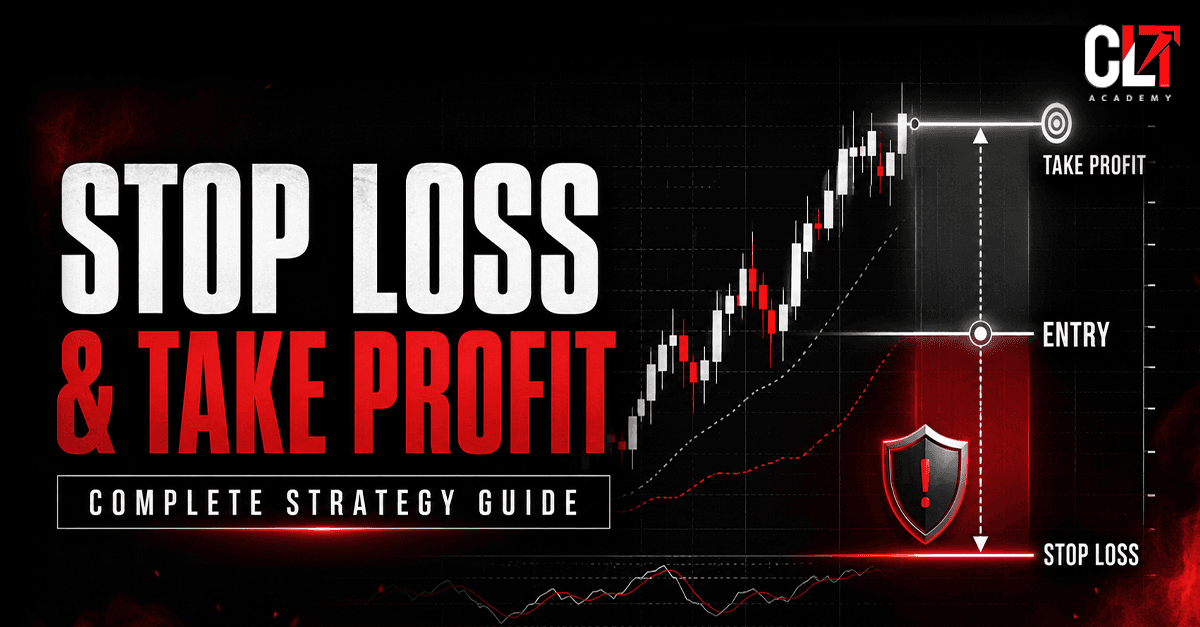
A good forex trade is not only about finding the right entry. It is also about knowing where the trade should end if the market moves against you and where you are willing to take your gains if it moves in your favour. For anyone looking for a practical stop loss take profit forex strategy, the goal is not to find a perfect number, but to create a clear and repeatable exit plan.
Many beginners spend most of their time looking for entries. They study charts, search for setups and wait for signals. But once a position is open, another set of questions appears: Where should I exit if the trade goes wrong? Where should I take profit if it works?
A stop loss defines a price level where a trader accepts that the original trade idea is no longer valid. A take profit defines a planned level for closing a profitable position. When both are decided before entering a trade, the trader has a clearer idea of the potential risk and expected reward.
This guide explains how stop loss and take profit work, how to place them using market structure and volatility, how position size affects risk, and how they connect with risk-to-reward.
Stop loss and take profit are not simply two orders placed on a trading platform. They are part of the thinking behind a trade.
Before entering, a trader should have an idea of what would prove the setup wrong and what price movement would represent a reasonable objective. This makes the exit part of the strategy rather than a decision made under pressure.
For beginners, this becomes even more important. A trader who focuses only on entries may know when to enter but have no clear answer when the market moves against the position.
At CLT Academy, trading education focuses on structured learning, strategy development, risk management, psychology and practical application rather than treating entry signals as the entire trading process.
A stop loss is an order designed to close a trade when price reaches a predetermined level against the position. For a long position, the stop is generally placed below the entry price. For a short position, it is generally placed above the entry price.
The purpose is not to predict exactly where the market will turn. Instead, it defines the point where the trader accepts that the original trade idea may no longer be valid.
Imagine a trader buys EUR/USD at 1.1000 after identifying a bullish setup. The trader finds a nearby swing low that supports the setup. If price breaks that level, the reason for taking the trade may no longer exist. That area can therefore become a logical reference for the stop loss.
A take profit is a predefined price level where a position is closed once the market reaches the trader's target.
For a long trade, the target is normally above the entry. For a short trade, it is normally below the entry.
Suppose a trader enters EUR/USD at 1.1000 and identifies 1.1050 as a reasonable target based on the trading setup. A take-profit order can be placed around that level. If price reaches the target, the position can be closed according to the order conditions.
The important point is that a take-profit level should have a reason behind it. It can be based on market structure, previous highs or lows, support and resistance, liquidity, volatility or the rules of the strategy.
The easiest way to understand the difference is to look at what each order controls.
There is no universal stop-loss distance that works for every forex trade. Stop placement should consider market structure, volatility, timeframe, strategy and the amount of capital being risked.
A stop can be placed beyond a meaningful technical level rather than at an arbitrary number of pips.
For a long setup, this could be below a relevant swing low or support area. For a short setup, it could be above a swing high or resistance area.
The important question is not “How many pips should my stop be?” It is “At what point does this trade idea stop making sense?”
A common mistake is choosing a fixed stop distance first and then searching for a chart structure that fits it. A better sequence is to identify the invalidation point first and then calculate the position size around it.
Markets rarely move in a perfectly straight line. Price can move against a position temporarily before continuing in the expected direction.
If a stop is placed too close to the entry, normal market fluctuations may trigger it before the setup has genuinely failed. This is why volatility matters when planning a forex stop loss.
A stop suitable for a short-term setup may not make sense for a wider swing trade. The timeframe and behaviour of the instrument should influence the amount of room given to the position.
A wider stop does not automatically mean a larger monetary loss.
Position size can be adjusted according to the distance between entry and stop. This allows a trader to maintain a planned level of account risk even when different setups require different stop distances.
For example, a trader may have one setup with a 25-pip stop and another with a 50-pip stop. If the trader wants to maintain similar monetary risk, the position size would need to change.
Take profit should not be selected simply because a particular price looks attractive.
The target should have a reason behind it. Depending on the strategy, that reason could come from previous highs or lows, support and resistance, liquidity areas, market structure, volatility or another defined method.
Some traders also use partial exits. They may close part of a position at one target while allowing the remaining portion to continue if the market keeps moving.
Stop loss and take profit become more meaningful when they are viewed together through the risk-to-reward ratio.
The risk-to-reward ratio compares the amount a trader is willing to risk with the potential reward of the trade.
For example, if a setup risks $50 and has a planned potential reward of $100, the risk-to-reward ratio is 1:2.
The relationship between risk and reward should be considered before entering the trade, not calculated afterwards to make a setup look attractive.
Consider a hypothetical EUR/USD long trade:
Several mistakes repeatedly appear when traders manage exits. The most common include placing stops too close, moving stops because of fear, taking profit too early and using the same stop distance for every trade.
A trader may place a very tight stop simply because they want to reduce the amount of money at risk.
But if the stop sits inside normal market movement, the position may be closed before the setup has a chance to develop.
One of the most damaging habits is moving a stop farther away when price approaches it.
The thought is usually simple: “Just give it a little more room.”
But repeatedly changing the stop can turn a predefined loss into an uncontrolled one. If a strategy allows the stop to move, that rule should be defined before the trade rather than invented during the trade.
The opposite problem is closing a winning trade simply because the trader is afraid that the profit may disappear.
This can create an unhealthy pattern where losing trades are allowed to reach their full stop while winning trades are closed too quickly.
A fixed number of pips may look simple, but different currency pairs, timeframes and market conditions behave differently.
A stop should make sense within the strategy and market environment rather than being copied mechanically across every setup.
There is no universal rule that says every strategy must use exactly the same exit method.
Some strategies use fixed targets. Others may use trailing stops, partial exits, time-based exits or exits based on changing market structure.
The important point is that the exit method should be tested and clearly defined within the trading strategy.
Stop loss and take profit should not exist separately from the rest of the strategy.
A complete trading plan can connect:
• Market analysis
• Entry conditions
• Stop-loss placement
• Position size
• Risk per trade
• Risk-to-reward
• Take-profit target
• Trade management
• Exit rules
• Trading psychology
• Post-trade review
A trader may know what a stop loss is, understand risk-to-reward and recognise a setup, yet still struggle because those ideas are not connected into one process.
Before clicking Buy or Sell, ask yourself:
• Where is my entry?
• Why am I entering here?
• Where does my trading idea become invalid?
• Where is my stop loss?
• How much money am I risking?
• What is my position size?
• Where is my take-profit level?
• Does the potential reward justify the risk?
• What will I do if price moves differently from expected?
• Am I following my plan or reacting emotionally?
If you cannot answer these questions before entering, the trade may not be fully planned yet.
Stop loss and take profit are more than two numbers placed on a trading platform. They are part of the decision-making framework that defines how much room a trade has, how much capital is at risk and where the trader intends to exit.
The best stop loss take profit forex strategy is not necessarily the one with the tightest stop or the biggest target. It is the one that fits the trading setup, market conditions, risk tolerance and overall trading plan.
When these decisions are made before entering a trade, traders can reduce the need for emotional decisions once the position is open. Risk management cannot remove market risk, but it can help make that risk defined and controlled within the trader's plan.
A stop loss is designed to close a trade when price reaches a predefined level against the position. A take profit closes the position when price reaches a predefined profit target.
There is no single stop-loss distance that works for every forex trade. Traders should consider market structure, volatility, timeframe and the point where the original trading idea becomes invalid. Position size can then be adjusted according to the amount of capital the trader is willing to risk.
There is no universal ratio that guarantees a successful trade. A 1:2 ratio means the planned potential reward is twice the amount being risked. However, the ratio should be considered alongside the strategy, probability of success, market conditions and execution.
5 October 2026 • 10 min read

23 September 2026 • 12 min read

17 September 2026 • 11 min read
Profit Matrix
8 weeks
Designed for traders who know the basics but lack execution clarity, this 8-week program dives into advanced trade planning, market psychology, and strategic precision. Take the leap from potential to profitability — and build habits that last a lifetime.
Market Code
14 weeks
Designed for experienced traders seeking structured mastery, this 14-weeks program unpacks high-level chart analysis, risk-to-reward systems, and real-time strategy execution. Elevate from scattered results to strategic consistency